
Veteran suicide remains one of the most urgent challenges facing the veteran community. 
According to the latest National Veteran Suicide Prevention Annual Report, more than 17 veterans die by suicide every day.
“Anyone can be at risk. Suicide is a human issue, not simply a mental health issue,” says Lyndsay Tkach, Mental and Brain Health director at Wounded Warrior Project® (WWP). “There is no single reason someone reaches the point of hopelessness that they consider suicide. Every person's story is different.”
Mental health conditions such as post-traumatic stress disorder (PTSD) and depression can contribute to suicide risk, but they are only a small part of what may lead someone to consider suicide. Often, a combination of factors intersect.
That’s why suicide prevention must begin long before someone reaches a crisis. “Every veteran deserves the opportunity to find healing, which is why Wounded Warrior Project has a goal of ending veteran suicide,” Tkach says.
As part of its efforts, WWP® works to identify risk earlier, understand what is happening in a veteran’s life that may increase risk, and create more pathways to care, stability, connection, and hope.
Recognizing Risk Before a Crisis
One of the biggest misconceptions about suicide is that it only affects people with a mental health condition, such as PTSD or depression.
“These conditions may contribute to a veteran’s risk, but many other life experiences can lead a person to contemplate suicide,” says Tkach. “Someone who is struggling with chronic pain, mounting financial pressure, the loss of a job or relationship, or loss of purpose, may also be at risk.”
Because suicide risk can stem from many different challenges, prevention must begin long before a veteran reaches a crisis. According to Tkach, it starts whenever and however a veteran first seeks support.
“Veterans connect with Wounded Warrior Project for many different reasons, often for things that on the surface have nothing to do with mental health,” says Tkach. “They may be looking for help finding a job, wanting to improve their physical health or sleep, or simply desire to connect with other veterans.” 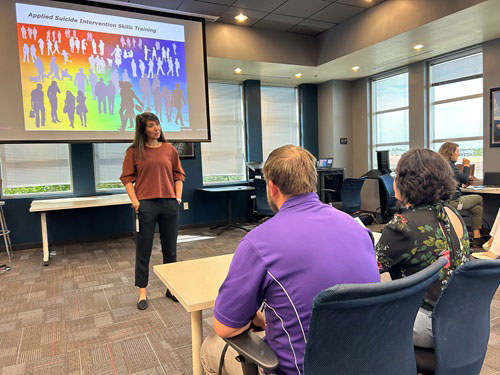
Each interaction allows WWP to assess risk and identify when someone may need more support. Regardless of why someone reaches out, suicide risk screening is standard across many WWP programs.
But screening is only one part of WWP’s broader suicide prevention efforts. Training is another.
All WWP staff complete Applied Suicide Intervention Skills Training (ASIST), a two-day workshop that helps them recognize warning signs and respond with care and compassion.
“Someone isn’t always going to tell you directly that they’re thinking about suicide,” says Tkach. “Often, it’s more subtle, like a change in their behavior or the language they are using. Training helps people recognize the signs and circumstances that may signal someone is struggling, even if they haven’t expressed thoughts of suicide.”
WWP also extends suicide prevention training beyond its staff, teaching community and corporate partners, other veterans service organizations (VSO), healthcare providers, first responders, and others who engage with veterans’ life-changing suicide intervention skills.
“The goal is to reach people before they are in a crisis. Knowing how to recognize signs that someone may be considering suicide — and how to intervene appropriately — is as important as knowing first aid,” she says.
For Tkach, every person trained is another step toward change. “The more people who have these skills, the closer we are to ending veteran suicide.”
Training by the Numbers
- 1,100+ people trained by WWP in 2026
- Nearly 500 of those participants were community partners, grantees, service members, warriors, and family support members.
- 6,300+ people trained over the past five years.
From Risk to the Right Support
Understanding what factors may be contributing to a person’s risk of suicide is critical to helping them get the right support.
“It’s important to peel back the layers, look beyond a diagnosis or a symptom, and understand the challenges that may lead someone to feel hopeless,” says Tkach.
Often, the full picture is more complex than it first appears.
She shares multiple examples:
- A veteran living with chronic pain may also be losing sleep, withdrawing from family, struggling to work, and becoming increasingly isolated.
- Another veteran may be unemployed and facing financial pressures that affect their housing, relationships, and sense of security.
- Someone else may be navigating PTSD, depression, a traumatic brain injury, or have difficulty finding purpose after leaving military service.
“Veterans often face overlapping challenges that affect their quality of life. Wounded Warrior Project’s role is to understand those issues and then develop individualized plans of care to help each veteran get the support that’s right for them,” adds Tkach.
WWP offers a range of programs and services directly. When additional support is needed, WWP partners with other VSOs, academic medical centers, and community organizations to connect veterans with the support that best fits their needs.
“Every veteran’s journey is unique. They deserve care that reflects their needs, experiences, preferences, and goals,” says Tkach.
That commitment also means identifying gaps and barriers to care as well as working to expand treatment options for veterans. Through its advocacy efforts, WWP raises policymakers' awareness of the challenges veterans face and opportunities to improve access to care and outcomes.
One promising area of focus, says Tkach, is advanced therapies, including psychedelic-assisted therapies, which have shown promise for veterans who have not found healing for PTSD and depression through traditional treatments.
“There isn’t a one-size-fits-all approach to care,” says Tkach. “But if something hasn’t worked for a person before, that doesn’t mean we should stop looking. We have to keep expanding what’s available to help every veteran find a path to healing.”
Learning From Veterans to Strengthen Suicide Prevention
Veterans and their experiences inform WWP’s work as an organization. Its approach to suicide prevention is no different.
According to the latest Warrior Survey*, more than 1 in 4 WWP warriors had suicidal thoughts in the past 12 months.
“The data from the Warrior Survey, along with suicide risk screenings, post-program surveys, and other research, provide valuable insight into factors affecting veteran well-being, including risk factors and protective factors for suicide,” says Tkach.
That knowledge helps WWP identify gaps in support, strengthen programs, inform partnerships, advance research, and guide advocacy efforts.
For WWP, collaboration isn’t separate from suicide prevention. It is part of it.
“No one organization can end veteran suicide alone. Progress depends on people working together to change the landscape,” says Tkach, who has represented WWP as a presenter at national conferences on the topic.
Committed to Building More Pathways to Hope
Ending veteran suicide is an ambitious goal, but it’s one WWP remains committed to pursuing.
“Wounded Warrior Project is always asking how we can shift and evolve to ensure veteran well-being. We are never satisfied, because even one suicide is too many,” Tkach says.