
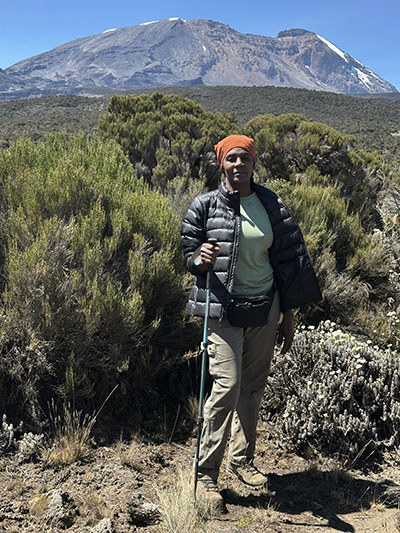
WWP warrior Tonya Oxendine stands in front of Mount Kilimanjaro in Tanzania.
The summit was close enough for Tonya Oxendine to picture herself standing at the top. After months of training, miles of steep terrain, and more than 15,000 feet of climbing, the 60-year-old Army veteran had only about a day and a half left before reaching the peak of Mount Kilimanjaro.
Then sickness and dizziness forced her to be medevaced off the mountain. She didn’t reach the summit, but the experience reshaped her understanding of success: Sometimes, it means still climbing.
Wounded Warrior Project® (WWP) honors and celebrates warriors by supporting their mental, physical, emotional, and financial well-being during and after service. Tonya’s journey reflects the spirit of warriors doing hard things — choosing challenge, facing uncertainty, and discovering strength beyond the outcome.
A Challenge She Couldn’t Pass Up
Tonya didn’t spend her life dreaming about mountain climbing. In fact, she said she had barely heard of Mount Kilimanjaro until a colleague shared her own experience climbing it.
The idea caught her attention right away.
The facts were straightforward: Mount Kilimanjaro is in Africa. It stands nearly 20,000 feet tall. And Tonya would be taking it on at 60 years old. Instead of seeing those facts as reasons to hesitate, she saw them as reasons to say yes.
“I love a challenge,” she said. “I wanted to see if I could actually do it.”
She applied for a spot on the climbing team and waited months to hear back. The call finally came in February, her birthday month. Tonya was selected to climb in July.
The timing made the challenge feel even more meaningful.
Tonya had always enjoyed staying active and pushing her limits, but mountain climbing was new to her. That was part of the appeal. It was unfamiliar, demanding, and uncertain — exactly the kind of test that made her want to find out what she was capable of.
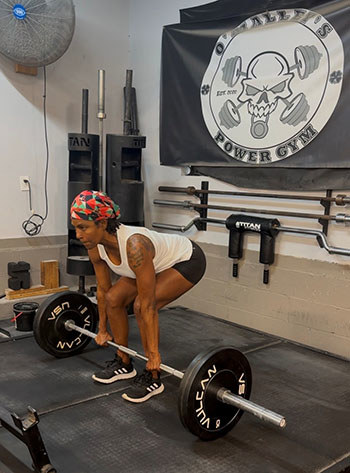
Tonya trained for months to prepare for her Mount Kilimanjaro climb, including powerlifting and trying to recreate breathing in high elevations.
Training for the Unknown
Once she was selected for the team, Tonya committed fully to the challenge.
She trained five to six days a week, often walking with a 35-pound pack, boots, and trekking poles. She started with shorter walks and then gradually worked her way up to four-, six-, and eight-hour training sessions. Eventually, she completed a 10-hour day on her feet.
Living in Florida, Tonya knew she couldn’t recreate Kilimanjaro’s altitude, but she did everything she could to prepare. She lifted weights. Climbed stairs. Walked on steep treadmill inclines. Logged miles in the heat.
Her preparation was creative and relentless. She tried to mimic the mountain however she could from below sea level. She even experimented with breathing masks and training tools designed to simulate elevation, though she quickly learned there is no substitute for true altitude.
No amount of training could fully prepare her for what waited on the mountain.
“Preparation doesn’t mean that I get to control the outcome,” Tonya said.
That understanding would become one of the climb’s most important lessons.
Before she left, Tonya tapered her training to give her body time to recover and be ready for the climb. The months of preparation came to a close. Her gear was packed. The planning was done. The climb was no longer an idea. It was waiting for her in Tanzania.
The Moment the Mountain Became Real
When Tonya arrived in Tanzania and caught her first glimpse of Mount Kilimanjaro, the moment felt larger than the climb itself. The mountain she had spent months preparing for was no longer an idea. It was real. It was right in front of her.
“There was no more getting ready at that point,” she said. “I was actually at Mount Kilimanjaro.”
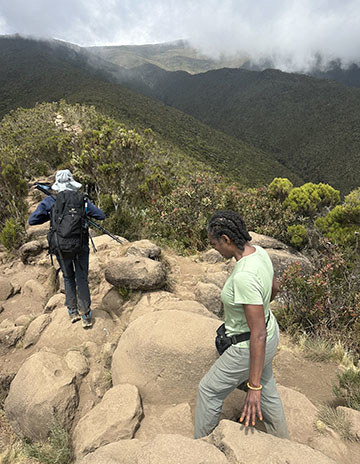
Tonya climbs Mount Kilimanjaro with a team from Sheep Dog Impact Kili Climb for a Cause.
For Tonya, arriving in Africa carried its own emotional weight. She said being there as a Black woman gave the trip a significance that went beyond adventure. The experience was about more than climbing a mountain. It was also about connecting with a place she had long wanted to see firsthand. She remembers the scenery, the sounds, and the culture of Moshi, the city near the mountain.
But once the trek began, her focus shifted to the challenge ahead.
The climb quickly became demanding. The team moved through changing weather and terrain, from warm lower elevations to chilly nights and early mornings at higher elevations. Porters carried tents, food, and supplies ahead of the climbers, setting up camp before the team arrived. Tonya said the support crew handled nearly everything so climbers could conserve their energy for the trail and, ultimately, the summit.
The days followed a steady rhythm. Wake-up came around 6 a.m., often with a warm bowl of water to wash up before breakfast. The group usually stepped off around 8 a.m. and walked for four, six, or eight hours, depending on the route and the team's pace. Some days stretched longer. Guides stayed with climbers as the group naturally separated into faster and slower packs, making sure no one was left alone.
Camp life surprised Tonya, too. Instead of the packaged meals she imagined, climbers ate hot food prepared on the mountain — soup, bread, greens, salad, tea, and protein-rich meals designed to keep them fueled.
Sleeping was a different story. The tents were pitched on the flattest ground available, but flat on a mountain still meant rocks, uneven terrain, and little comfort. However, by the end of each day, Tonya said the exhaustion took over. Everyone was tired enough to sleep.
When Endurance Met Its Limit
The second day of the climb tested Tonya in ways she hadn’t expected.
The route included a steep section Tonya described as “Elephant’s Back,” a climb that felt every bit as difficult as its name suggested. The first day had gone well. By the second, something felt off. She did not feel right. By the third and fourth days, Tonya was moving behind the group, struggling to keep up with what her mind still wanted to do.
By the fifth day, after climbing more than 15,000 feet, the team made the difficult decision to evacuate her by helicopter. She later learned she was battling altitude sickness and a bacterial stomach infection.
“It just gutted me,” she said. “I had a day and a half left to summit. I made it over 15,000 feet … and I was just so hurt, disappointed, and angry.”
The hardest moment came as she walked toward the helicopter landing area. Before leaving, she turned around and saw her teammates continuing up the mountain, while she headed down.
“Everybody was going up the mountain, and my health was going down,” she said. “I really wanted to summit. I had trained for that and worked so hard.”
Redefining Strength
The disappointment of being evacuated from the mountain early only expanded Tonya's understanding of strength. The military taught her to push harder, endure more, and never quit. Kilimanjaro didn’t undo those lessons. It just added a new one.
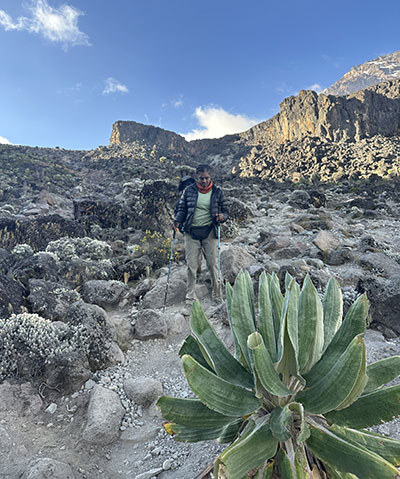
Sickness kept Tonya from reaching the summit of Mount Kilimanjaro, but didn't prevent her from striving to challenge herself, and she hasn't ruled out a return to the mountain.
“Strength can also mean asking for help,” she said. “Courage can mean trying something that you didn’t know how it was going to turn out.”
She also learned that strength can mean accepting a decision made to protect you and the people around you. Tonya believes she would have kept going if the team had not stopped her. Looking back, she understands that continuing could have put both herself and others at risk. Turning back was not weakness; it was wisdom.
“I learned that I don’t have to reach every finish line to value what I experienced to get there,” she said. “Can I be disappointed and still be proud of myself? The answer is yes.”
That realization challenged a definition of success she had built over a lifetime of military service, fitness, and personal drive. Had she reached the summit, Tonya believes she would have returned proud of an incredible accomplishment. But not reaching it forced her to ask deeper questions: What does success mean when the outcome is not the one you trained for? Can effort still matter when the mission is incomplete? Can disappointment and pride coexist?
“I think I learned more about myself because I didn’t summit than I probably would have learned if everything had gone according to plan,” she said. “I got a different perspective on my life.”
Still Climbing at 60
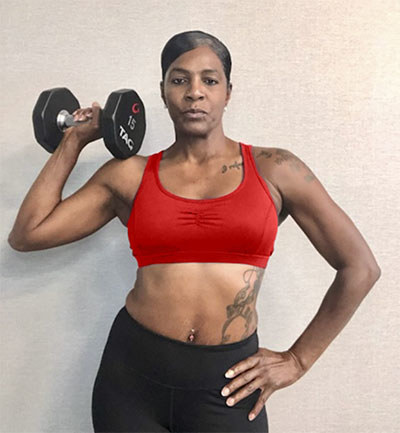
At 60, Tonya isn't slowing down and is continuing to train and prepare for whatever adventure comes next.
At 60, the climb also changed the way Tonya thinks about aging. Turning 60 did not make her want to slow down. It made her wonder what else she could do.
“I don’t see 60 as the end of anything,” she said. “If anything, I think it makes me think, ‘OK, what else is out there?’”
The mountain did not make her want to stop challenging herself. If anything, it made her more curious.
She is already thinking about what comes next. Tonya is currently training for the Army Ten-Miler and taking boxing classes. And while she came home with a different understanding of success, she hasn’t completely closed the door on Kilimanjaro. She’s seriously considering going back.
Her advice to others is not to wait until fear disappears or until the outcome is guaranteed. Prepare. Do the work. Give it your best effort. Then be open to wherever the journey leads. Success may not look exactly the way you pictured it.
“Sometimes you’re going to reach the summit,” she said. “Sometimes you won’t. But one outcome doesn’t define your entire journey.”
Tonya never stood on the summit of Mount Kilimanjaro, but she came home with a wider view of what it means to keep climbing. Tonya now wears a bracelet that says “still climbing,” a phrase that has become more than a reminder of the mountain.
“It’s never really been about the mountain,” she said. “It’s about life. As long as I’m still breathing, I’m still living. And as long as I’m still living, I’m still climbing.”